

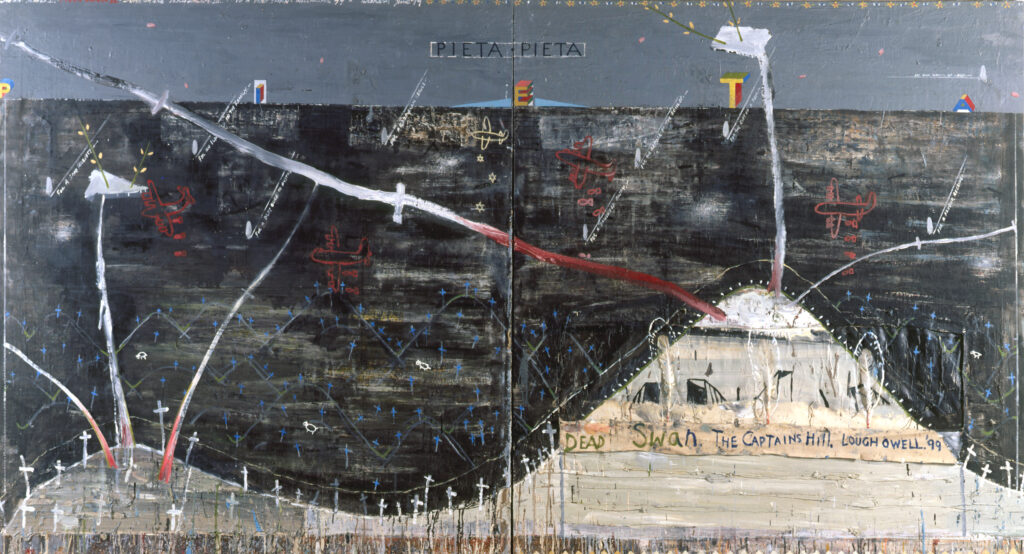
Located at the corner of California and Lake, this bite-sized bonbonniere of an intimate art space houses only a handful of Graham’s large-scale paintings and mixed-media work on paper, which span decades. These dense, layered transfigurations of spirit to material form generate such seismic force that loading any more of them into Rutberg’s sleek, compact gallery would likely set the Pacific and North American Plates to trembling.
Rutberg, who has known Patrick Graham for decades, says “He reveals himself without exhibitionism. I have several of his paintings in my home, and they continue to confound me, challenge me. They change before my eyes each day. Because you never enter a great painting at the same place. Real art reveals itself, then hides itself again. Wallpaper…” (…by “wallpaper,” Rutberg means formulaic painting,) “…you get instantly.”
Patrick Graham does not have a Web site, and is not to be confused with artist Patrik Graham, who does. Patrick with a “c” is reclusive, and rarely leaves his native Ireland, which may be why you may not readily know his name or his work, although he was artist-in-residence at Pasadena City College in 1991.
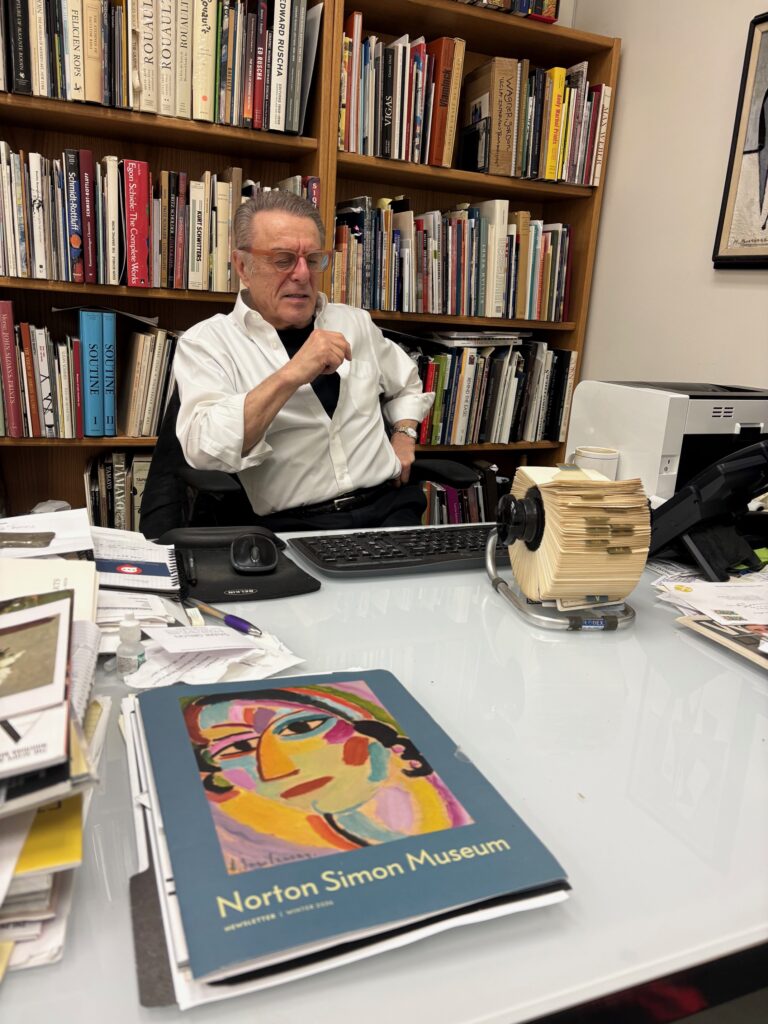
Art critics, historians and gallerists including Rutberg credit Graham with bringing Irish visual art into the 21st century, finally in league with the country’s luminous and vast literary heritage.
“Personal expression in the visual arts was quite absent from Ireland,” says Rutberg. “You had religious painting, and English landscape painting. The only other alternative was sign-painting for shops and lettering on the sides of trucks.”
Prior to Graham, Irish artists emulated the academic painting style of English masters, and the classicism of European painters. While the dark art of Francis Bacon may come to mind, Graham’s work is less figurative, more symbolic, and more technically complex. Irishness pervades it, from avian references to the
wren, the bird whose Irish name dreoilín means “trickster,” to the lark in the morning, a bird referencing a traditional and often bawdy folksong, to the tragic tale of the Swan-Children of Lir, to the inevitable confrontation of Mother Church.
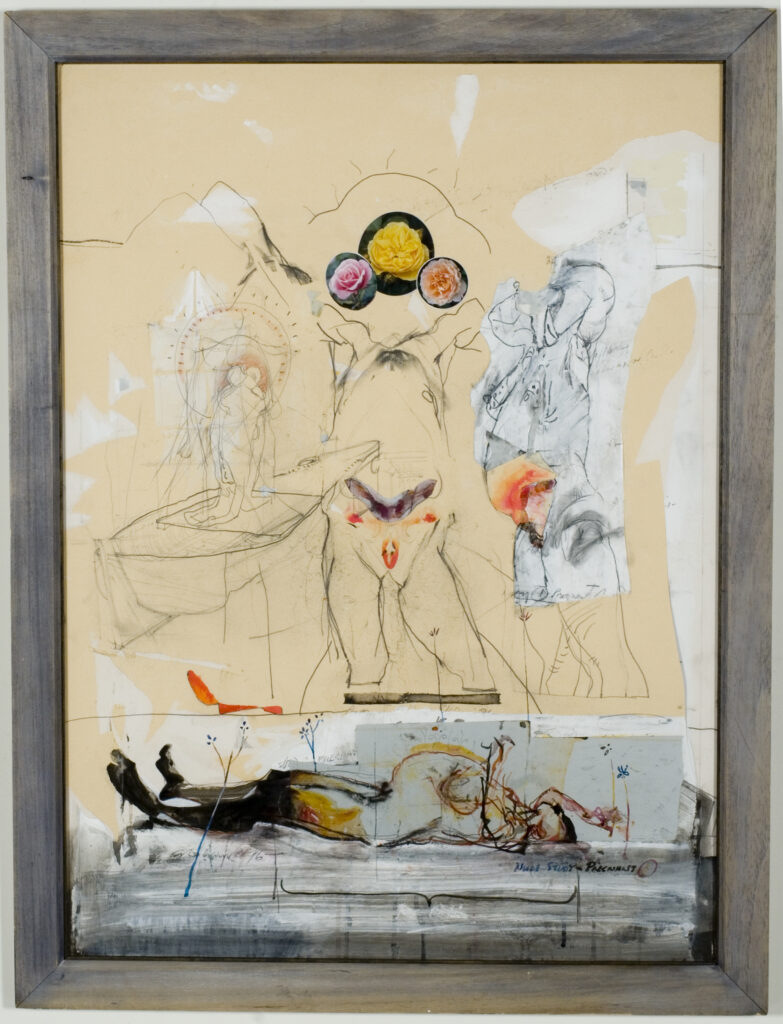
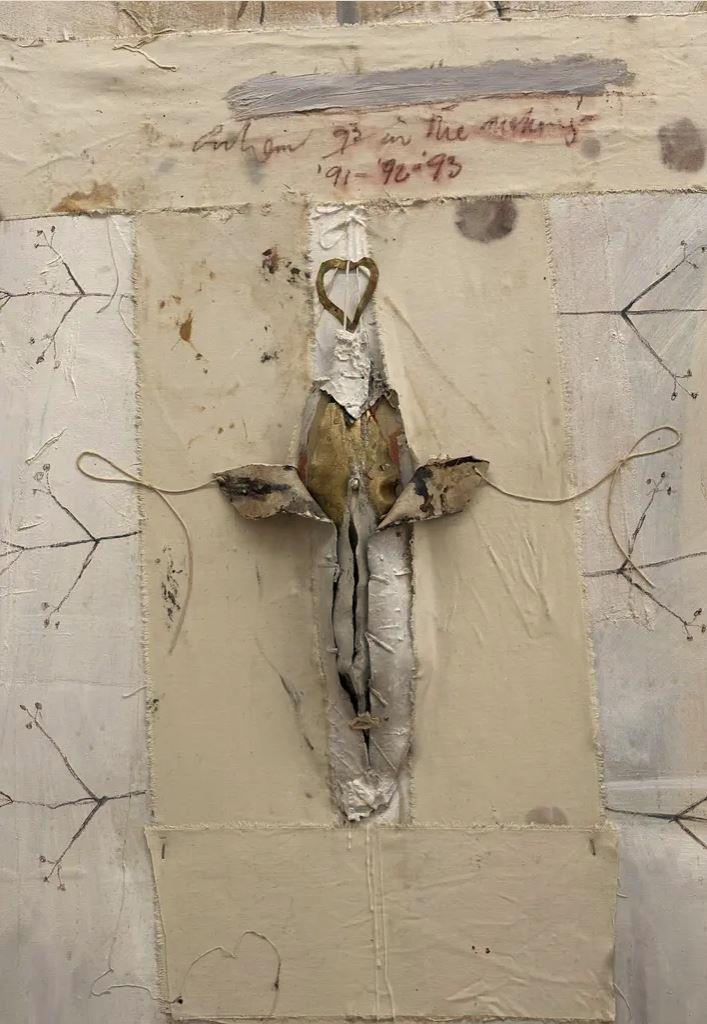
Graham’s huge works appear as flesh. There are open wounds, stitches, and visible scars, stigmata. They seem to bleed, or weep.
Graham’s canvas and paper surfaces are translucent, shredded, ripped, puckered, folded, punched, battered, tattered, swollen, sunken, pierced, punctured, bruised. Areas are erased, masked, bandaged, buried, painted over, scabbed with layers of paste, tape, cloth, photos snipped from magazines, and, in one notable case, a handful of medicinal glitter, plumbing the foul rag and bone shop of the heart. Graham integrates tattoos of feverish text that rise and drift like chants through the fog of perception and memory, the way one may mutter to oneself between wakefulness and dreaming, akin to Molly Bloom’s closing soliloquy in James Joyce’s Ulysses.
The artist began as a lad in Mullingar, County Westmeath. To quote Yeats, “Being Irish, he had an abiding sense of tragedy, which sustained him through temporary periods of joy.” Graham’s father exited the family to find work outside of Ireland when Graham was four or five years old. Following that, the artist’s beloved mother contracted tuberculosis and the boy was sent to live with his grandparents, whom he describes as decent but emotionally remote people.
From the midst of these and other hardships, one might say a terrible beauty was born. Graham was a prodigy, displaying what he calls an “unearned gift” at an early age. That gift was an unschooled talent for classical drawing.
The skill which brought him much immediate adulation soon became the scorned albatross from which he had to break free at tremendous personal cost. He’s still praised as a supernaturally superb draftsman as well as a Neo-Expressionist, both terms which Rutberg says are inadequate to describe the indescribable. Rutberg says, “Patrick threw away his facility. Even when he was quite young, he said that academic drawing was just for the eyes. He knew that art needed to reach the heart and soul on a much more basic, primal level.”
Because of his precocious talent, Graham received a prestigious scholarship to art college, first at age 13 when he was too young to attend, and then again at16, when he did enroll. But he quickly dismissed what he calls his “tricks,” technical mannerisms and affectations which he says promised him a sort of immortality, as an academic genius.
He wanted none of it.
Mullingar is home to the massive Cathedral of Christ the King, built with a seating capacity of 5,000 in 1936. The omnipresence of Roman Catholicism in Graham’s art and being cannot be overstated, including his primary education at the hands of the notoriously sadomasochistic Congregation of Christian Brothers. In RTÉ radio interviews, Graham has remarked that the Ireland of his youth was “…dominated by religion. People these days can’t realize the terror us kids had toward education and the experience of being in school. My only way to get through was to say nothing, and to hide. Oppressed priests ruled the world. They beat people senseless.”
Young men often joined the Christian Brothers lay order in their teens, and were instructed by clergy to practice self-flagellation and other mortifications of the flesh to rid themselves of impure (usually sexual) impulses. This practice of sanctified violence was extended quite readily to the students, who often were impoverished, frequently born to single mothers and surrendered to the Brothers early in life.
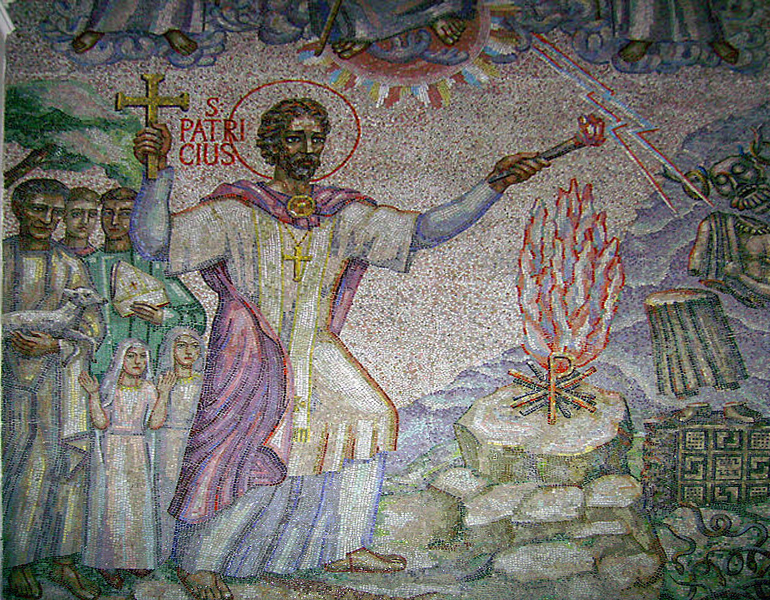
The Cathedral houses a mosaic of singular beauty created by Russian artist Boris Anrep, depicting Ireland’s patron saint,
Pádraig (Patrick), unveiled five years after Patrick Graham was born. The mosaic depicts the saint ending (ostensibly) Ireland’s heathen ways by lighting an Easter-Eve fire upon the Hill of Slane circa 433 C.E.
Anrep’s mosaic depicts firewood arranged into the Chi-Ro Christogram, a hissing tangle of snakes—loathed Druid priests in reptile form—which Patrick famously drove out of Ireland, and the saint’s toppling of a statue of the Celtic deity called
Cernunnos, whose name means “horned” in the Irish language.
The antler-crowned Lord of the Wild has much in common with Pan, both protectors of the natural world who were literally demonized into Satanic form by the church fathers. Graham’s personal history seems to mirror this ancient story, with his re-wilding of the self becoming essential to his literal survival, as well as his fullest expression as an artist.
Purgation is a common theme in Catholic tradition, on earth, in Purgatory, and perhaps beyond. It is a theme which follows Graham. The artist describes his experience visiting a small cemetery when he and his wife lived for a while in Mayo. The cemetery contained a bronze statue of a British soldier wearing a pith helmet and hoisting a musket, so Graham went to investigate.
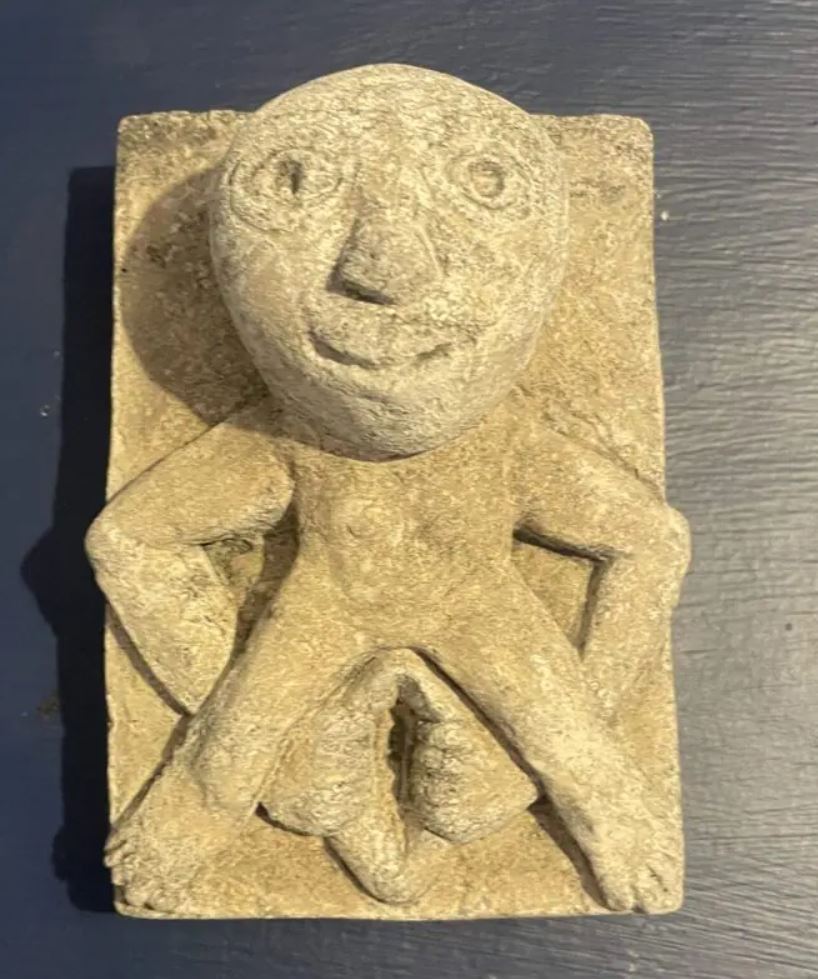
He recalls that crumbling at the base of the aging statue was a Sheela-na-gig, the archetype of the vulva’s generative and
apotropaic powers. Perhaps the monument served as yet another assertion of England’s colonial and Christian victory over Eire’s filthy pagan ways.
In more local terms, the analogy is Nuestra Señora de Guadalupe traditionally shown daintily trampling a snake and a crescent moon, symbols of her victory over the indigenous gods of the underworld, much as Patrick vanquished the lunar runes and serpents of the horned forest god.
This re-wilding also parallels the experiences of many artists, including Emil Nolde, an artist whose work according to Rutberg hit Graham “…like a punch in the gut. Nolde cut him in half. The art offended him.”
Nolde is usually called one of the earliest German Expressionists, although he was Danish by birth. And although he was openly anti-Semitic and a supporter of the National Socialist German Workers’ Party in the 1920s, the Reich nevertheless condemned his work as “degenerate art” and confiscated more than 1,000 of his paintings from German museums and personal collections.
Perhaps to confirm the ascendancy of gentile Europeans, Nolde often painted subjects that he might have termed exotic and “primitive”, as well as Gauguin-like tropical scenes from his excursions to the Philippines and German New Guinea circa 1913. Graham has never sailed to the South Seas, but his encounter with Nolde’s raw and shocking art led to his re-wilding in less scenic settings, namely the mental hospital where he landed during what was essentially an 18-year alcoholic blackout.
Irish-born psychiatrist Garrett O’Connor, who served as Medical Director ofthe Professional Recovery Program at the Betty Ford Center, coined the term malignant shame as a key driver of addiction among Irish and Irish-American people, tracing the common phenomenon to 800 years of post-colonial and genocidal oppression in Ireland, and generations of historical and familial trauma.
While this experience is hardly unique to Hibernians and their progeny, there is a uniquely Irish variety. Because Irish names and faces are so commonplace in America, it may seem remarkable to some that even as recently as the last century, Irish people were subject to racism. Familiar illustrators of the day including Thomas Nast, who drew the world’s most-recognized image of Santa Claus, and John Tenniel who drew Alice, portrayed the Irish as simian and sub-human, prone to Papist superstition, drunkenness, and violence.
The combination of British erasure of Irish ethnic and cultural identity, paired with punishing religious dogma, all reinforced by
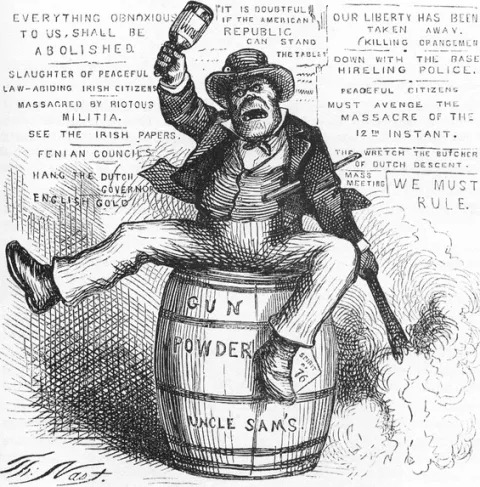
secrecy and a strict code of silence and denial, whip up a witch’s brew of whiskey-fueled self-loathing and rage that continues to fester, ferment, and bubble to the surface, even among beloved contemporary entertainers, for example. Rest in peace, David Cassidy, Jeff Conaway, Sinéad O’Connor, Dolores O’Riordan, Shane McGowan…
While Graham was institutionalized, he drew a portrait with photographic accuracy of a fellow patient whom he called “The Collector” for the man’s penchant for gathering twigs and bits of string. The subject was completely unimpressed and apparently unmoved by the portrait, a moment which solidified once and for all Graham’s dismissal of his pristine academic drawing technique as hopelessly empty.
Rutberg comments, “The experience of encountering Nolde, further confirmed by ‘The Collector,’ was a lightning bolt. It left him stranded. All he had was his gift, and he couldn’t cope. He’s told me that his first drink was a revelation, and he remembers taking that first drink. He talked to the booze, and it gave him a sense of unified oneness. Eighteen years later, a Jesuit priest gave him the last rites, more than once.”
Through whatever mystery, or miracle, Graham made the conscious decision to live. When he had stopped drinking he felt that he had no other life to enter. Confronted by his own psychic and physical wreckage, he began to attack the blank canvas, leaving what seemed like random marks and smudges. Of those years, he has told interviewers “I was creating an angry new language. I’ve a lot of people to blame.”
As William Butler Yeats wrote in Remorse for Intemperate Speech:
Out of Ireland have we come,
Great hatred, little room,
Maimed us at the start.
I carry from my mother’s womb
A fanatic heart.
He reconstructed himself by picking up his brush, and has said that the “ugly as sin” paintings he made then “taught me how to be a person.”
Rutberg reveals that Graham is ruthless in what the artist calls “interrogation,” often completely obliterating a seemingly finished piece to dig out something more authentic. This is the case with the work called The Captain’s Hill, which began as a relatively representational self-portrait. Dissatisfied, Graham smothered the original likeness in thick pigment to create a totemic image of the place where, as a child, he would climb into the sheltering trees and disappear.
“He destroyed a lot of his work,” says Rutberg. “I literally have picked some of these things, what Patrick calls his ‘bits,’ out of the trash. He would say that he had no one to save it for, no one in Ireland, but I didn’t listen.”
Awakening with the taste of ashes has given way to understanding and forgiveness in Graham’s art, although he continues to portray the human form with what feels like existential dread. This quality remains aligned with one of the essential riddles of old-line Catholicism which reviles the flesh, especially when sexual, and most especially when feminine, yet employs the ravaged body, seven sacred lesions, the pierced, flaming heart and precious blood of Jesus as its central metaphor.
Stylized cruciforms and bulging chalices abound in the backgrounds of Graham’s work, sometimes resembling the ripeness of the uterus and its outspread arms, or horns as they are often, perhaps disturbingly, called in medical texts.
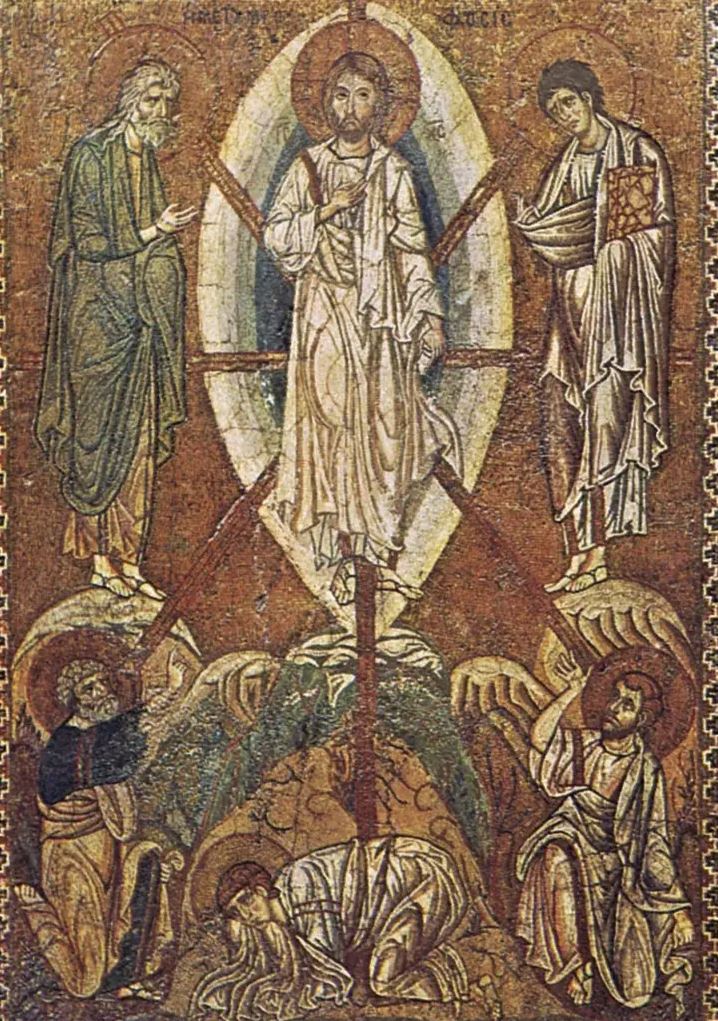
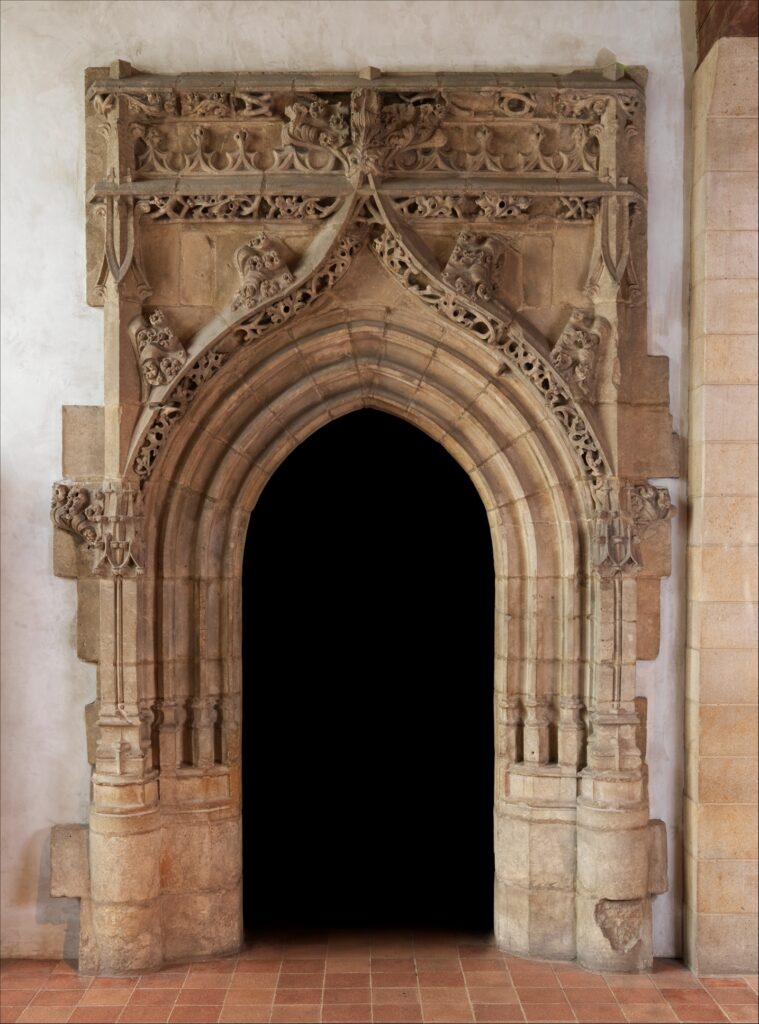
These archetypes toll in the unconscious like a summoning bell. Even the most casual observer will recognize the unconscious persistence, for example, of the vulva imago from prehistory through the Gothic period, from the grinning
Sheela-na-gig, to the almond-shaped mandorlas of medieval mosaics, to ruffled, Yoni-like entryways to ancient churches, to Graham’s current work, where the perhaps-artificial boundary between sacred and profane dissolves. He reports that he still reads his Bible, now for the beauty of its poetry.
“When we first met, Patrick didn’t have a telephone,” claims Rutberg. “He would write me these letters with this absolutely gorgeous European handwriting, that kind of schoolboy penmanship that is no more. I loved getting them, but I told him I couldn’t read a thing. So then he would write tome on sheets of graph paper, neatly filling in every square, completely precise and meticulous.” Rutberg says he’s grateful for email.
Let us remember that the English word vulnerability comes from the Latin vulnus, wound.
“As raw as this work may seem initially,” says Rutberg, “I know Patrick, and he is on a path back to his own innocence. He loves the magpies and wildflowers, and talks about the smell of the earth right after a rain, which of course is pretty much a daily occurrence where he lives. He has told me that after he stopped drinking, he felt his life and his world were just held together by threads. That frailty, that fragility is such a powerful voice in his art now.”
DETAILS:
- Patrick Graham: Notes From Ireland
- Jack Rutberg Fine Arts
- 600 South Lake Ave #102, Pasadena, CA 91106
- – Fri. 10am – 6pm; Sat. 10am – 5pm
- Through April 18th
- 323-938-5222
- jackrutbergfinearts.com
~ Victoria Thomas has been a journalist since her college years when she wrote for Rolling Stone and CREEM. She received a National Arts & Entertainment Journalism Award in 2025, and the 2024 Southern California Journalism Award for Best Lifestyle Feature from the Los Angeles Press Club. Victoria received additional awards for her Local News Pasadena reporting in 2023.