


A gallery show opening this month offers a quiet corrective to the art world's obsession with the new and rediscovers the California city that helped start it all.
There is a house, or rather the ghost of one, a few blocks from a gallery on South Lake Avenue in Pasadena where, sometime around 1907, a boy named Sandy fashioned figures from wire in a basement studio his father had built for him. He watched horses pull chariots at the Tournament of Roses and was never quite the same afterward. The boy was Alexander Calder. The rest, as they say, is art history – his famous circus, his mobiles, his transformation of sculpture into something that breathed with the air around it. That Pasadena shaped even a fragment of his imagination is precisely the kind of revelation that Jack Rutberg wants you to know about.
Rutberg, whose Jack Rutberg Fine Arts is among the longest-established galleries in Los Angeles, opens his new exhibition, Pasadena: L.A.’s Art Legacy, on June 7, and it is a show with a thesis –one he pursues with the patience of a scholar and the ardor of a true believer. Pasadena, he argues, is not the genteel, rose-lined footnote to the Los Angeles art world that history has allowed it to become. It was, in ways that have been quietly forgotten, the beginning.
“Art didn’t start in Pasadena,” Rutberg acknowledges, with the careful precision of a man used to provenance. “But it was a critical beginning.”
The exhibition – 70 works by nearly 60 artists, spanning centuries…is Rutberg’s evidence. Each piece was drawn from his gallery’s own holdings and selected against a single criterion: that the artist had a documented history with one of Pasadena’s great institutions. The Huntington, which opened to the public in 1918. The Pasadena Art Museum, which preceded and later yielded to the Norton Simon. The former Pasadena Museum of California Art. Even Pasadena City College. Together, these institutions mounted exhibitions of astonishing ambition and range; a fact the broader art world has largely declined to remember.
The show’s most arresting provocation hangs on a wall label, not a canvas. Beside two prints by Jacques Villon, the older brother of Marcel Duchamp, shown at the Pasadena Art Museum in 1966, is reproduced Julian Wasser’s famous photograph: Duchamp himself, playing chess with a nude Eve Babitz, taken at the occasion of Duchamp’s own legendary 1963 retrospective at that same museum. The image is perhaps the most iconic document of the American avant-garde’s great westward migration, and it happened in Pasadena. It is the kind of detail that makes one want to revise entire mental maps.
The works themselves traverse a sweep of Western art that is breathtaking in its confidence. Francisco Goya’s etchings. An original Piranesi. Sculpture by Degas. James McNeill Whistler, Auguste Rodin, Paul Klee, Marc Chagall, Louise Nevelson, Man Ray, Ed Ruscha — these names appear not in the hushed alcoves of encyclopedic museums but in a gallery on a busy Pasadena avenue, accompanied by price tags that, Rutberg is at pains to point out, need not terrorize. “Historic relevance doesn’t necessarily correspond to dollar value,” he says, “and that too will surprise visitors.”
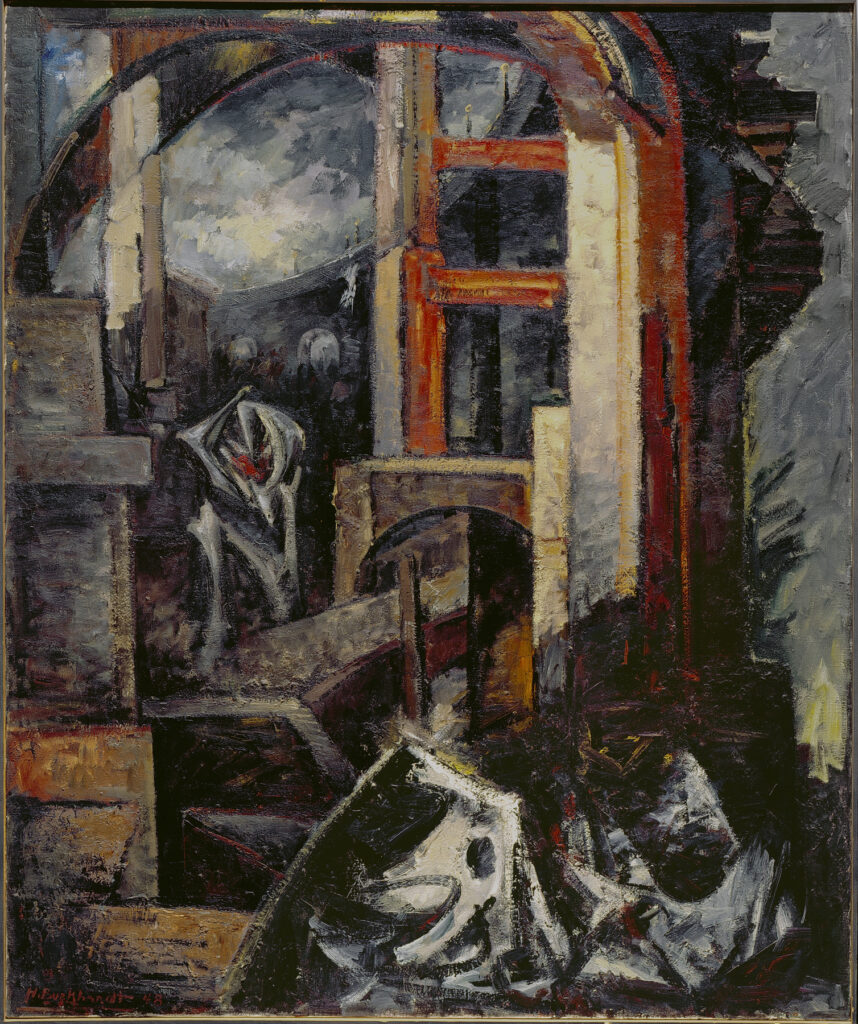
Among the most quietly powerful works is Hans Burkhardt’s large 1948 painting of the Colorado Street Bridge, the city landmark long shadowed by its grim reputation as a site of suicides, known locally as “the suicide bridge.” Where other artists have rendered it in realist serenity, Burkhardt, working in an expressionist, almost surrealist vein, seems to feel the weight of its history. The Pasadena Art Museum gave Burkhardt a mid-career retrospective in 1957. That we need a commercial gallery to remind us of this fact is part of what the exhibition is about.
There is also a recently rediscovered 1887 oil by Henri Fantin-Latour, a Bouquet of Flowers, being exhibited for the first time, alongside two lithographs that together constitute a small, accidental retrospective of that painter’s quieter ambitions: his sisters embroidering, a scene from Wagner. Three works, three decades, one vision. The Norton Simon holds a Fantin-Latour of its own. The Pasadena Art Museum showed his work twice, in 1953 and 1970. These facts, assembled, add up to something: a continuous cultural life, nourished across generations, that simply never announced itself loudly enough.
This, Rutberg suggests, is Pasadena’s particular tragedy and its paradox. The city has always had artists – a large and active community, he says, that persists to this day. What it never quite had was a gallery culture to give them a commercial and critical foothold at home. Most showed elsewhere. The institutions did the serious work. And then the institutions struggled, as institutions do, and the Pasadena Art Museum eventually passed to Norton Simon, whose collection transformed it into one of the finest mid-sized museums anywhere in the world. A consolation, certainly, but one that came at the cost of a certain civic memory.
Pasadena: L.A.’s Art Legacy is, on one level, an act of recovery; a gallery owner going deep into his own holdings to reconstruct a history that the city itself has forgotten to claim. But it is also, in its quiet way, an argument about how we look at art and where we encounter it. Rutberg is openly impatient with a contemporary art world that prizes novelty over context, emerging artists over the long view. “There’s not an easy way,” he says, “for art to be contextualized historically.” His show offers one.
It opens June 7 and runs through August 29. Sandy Calder’s basement is long gone. But some of what was made in its spirit, it turns out, has been here all along.