


PASADENA, CA.- Long before Los Angeles became internationally recognized as a major center for contemporary art, Pasadena’s museums, schools and cultural institutions were already introducing Southern California audiences to many of the artists who would come to define modern and postwar art. Jack Rutberg Fine Arts is bringing that history into focus with Pasadena: L.A.’s Art Legacy, an expansive exhibition assembling 70 paintings, drawings, prints and sculptures by nearly 60 artists from the gallery’s holdings.
The exhibition grew out of research undertaken after Jack Rutberg Fine Arts relocated to Pasadena. Looking closely at the exhibition histories of local institutions revealed a striking pattern: generations of internationally significant artists had been presented in Pasadena museums and schools, often at particularly important moments in their careers, even though the city never developed a sustained commercial gallery scene comparable to that of Los Angeles.
That disconnect became the starting point for the show. Each work is accompanied by information connecting the artist to exhibitions at Pasadena-area institutions, creating a visual history of the city’s role in the development of Southern California’s cultural identity. The presentation draws connections among the Pasadena Art Museum, Norton Simon Museum, The Huntington, Pasadena City College and ArtCenter College of Design, among others.
One of the exhibition’s most unexpected stories involves Alexander Calder. The artist lived in Pasadena as a child from 1907 to 1909, only a short distance from the gallery’s current location. His father created a basement studio where the young Calder, known as “Sandy,” made drawings and constructed objects from wire and other materials. His exposure to the Tournament of Roses and its horse-drawn spectacles may also have helped nurture the fascination with performance and the circus that later emerged so memorably in Calder’s Circus of 1926.
The exhibition repeatedly uses such connections to complicate familiar narratives of American art history. Marcel Duchamp’s celebrated 1963 retrospective at the Pasadena Art Museum is recalled through the story of Julian Wasser’s photograph of Duchamp playing chess with Eve Babitz.
Rather than treating the episode simply as a piece of local cultural lore, the exhibition places it within a broader network of artists who passed through Pasadena’s institutions. Works by Duchamp’s elder brother Jacques Villon, who exhibited at the museum in 1966, are also included.
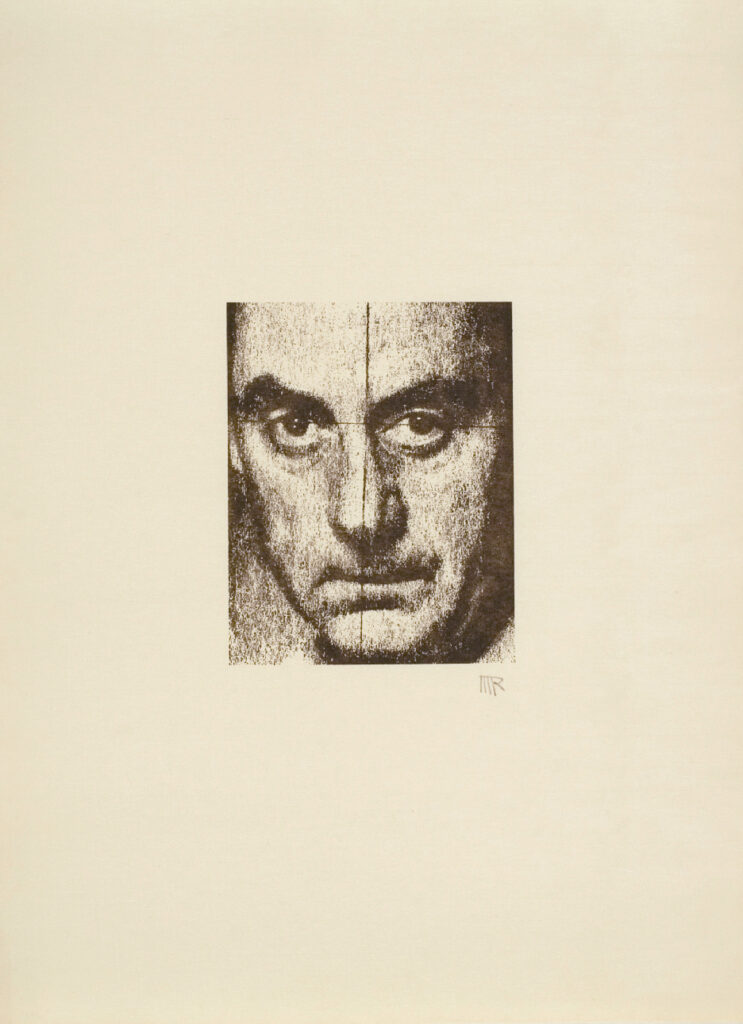
The range of artists underscores just how broad Pasadena’s engagement with modern and contemporary art became. Works in the exhibition represent figures including Karel Appel, Hans Burkhardt, Calder, José Luis Cuevas, Claire Falkenstein, Lorser Feitelson, Oskar Fischinger, Llyn Foulkes, Sam Francis, Frederick Hammersley, George Herms, René Magritte, André Masson, Robert Motherwell, Louise Nevelson, Man Ray, Ed Ruscha, Alison Saar, Mark Tobey and Ruth Weisberg.
The historical reach extends well beyond the postwar period. The show also includes works by Giovanni Battista Piranesi and Jacques Callot, artists whose presence reflects the Pasadena Art Museum’s willingness to present historical material alongside modern experimentation. The museum showed Callot in 1961 and 1964 and presented Piranesi in 1965. Francisco Goya is represented as well, continuing a lineage that connects Pasadena’s institutions with centuries of European printmaking and painting.
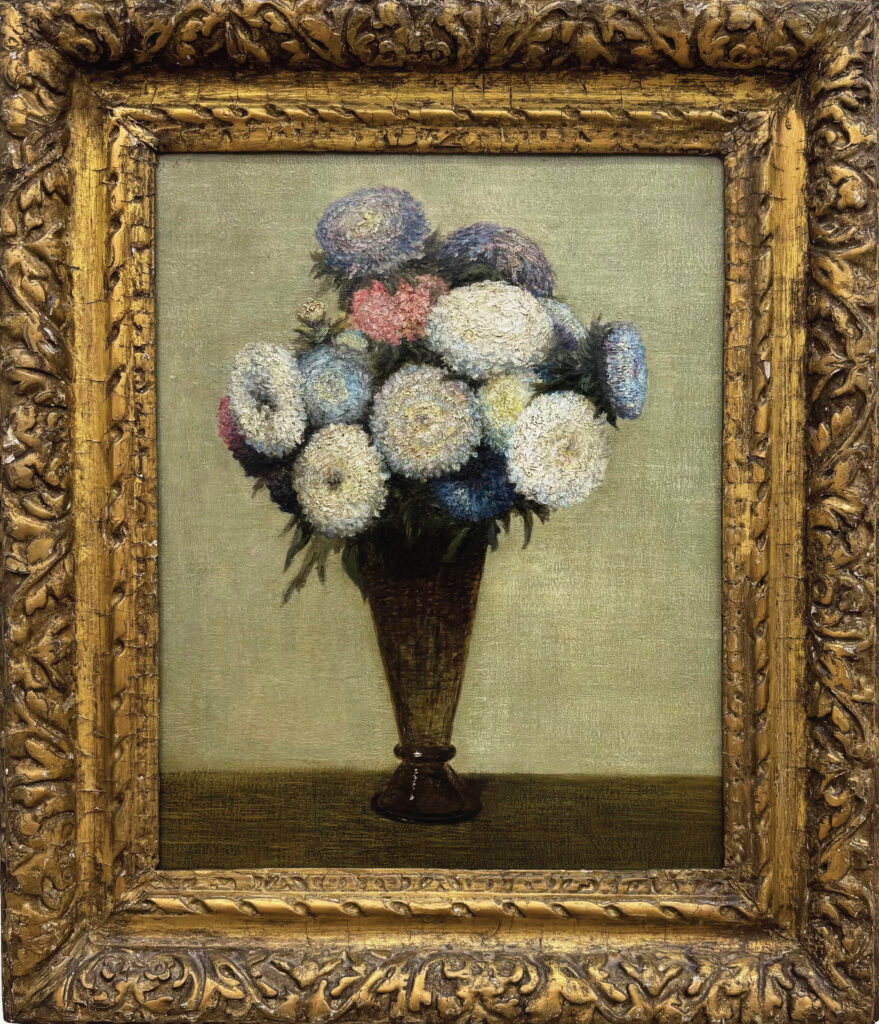
Another highlight is a recently rediscovered 1887 oil painting by Henri Fantin-Latour, Bouquet of Flowers. The exhibition also includes two of the artist’s original lithographs, one depicting his sisters embroidering and another inspired by a Wagnerian opera. Together, the three works offer a compact view of distinct areas of Fantin-Latour’s practice. His connection to Pasadena is substantial: the Pasadena Art Museum organized exhibitions devoted to his work in 1953–54 and again in 1970, while the Norton Simon Museum holds an important flower painting by the artist.
Local geography becomes particularly charged in Hans Burkhardt’s Pasadena Bridge of 1948. Rather than treating the Colorado Street Bridge as a straightforward city landmark, Burkhardt approached it through his expressionist and surrealist vocabulary, drawing attention to the darker history that earned the structure its longstanding nickname, “the suicide bridge.” The Pasadena Art Museum later presented a mid-career retrospective of Burkhardt in 1957.
The exhibition also places these works alongside earlier masters including Edgar Degas, James McNeill Whistler, Honoré Daumier, Auguste Rodin, Aristide Maillol, Max Klinger, Pierre Bonnard, Édouard Vuillard, Georges Rouault, Alexander Archipenko, Käthe Kollwitz, George Grosz, Paul Klee, Stanton Macdonald-Wright, Morgan Russell, Marc Chagall, Alfredo Ramos Martínez and Diego Rivera. The result is less a conventional survey organized around a single movement than a series of overlapping histories showing how Pasadena institutions engaged with artists across periods, countries and media.
Jack Rutberg Fine Arts has long positioned contemporary art within a wider historical context, and Pasadena: L.A.’s Art Legacy extends that approach by bringing museum history directly into the gallery.
The works are not presented simply as objects by recognizable names; their histories in Southern California become part of the experience of seeing them.
That approach also challenges assumptions about collecting. The exhibition includes works in a range of media and price levels, emphasizing that historical importance does not necessarily move in step with market value. Against a backdrop of headlines dominated by multimillion-dollar auction records, the gallery makes a different argument: significant works with meaningful cultural histories can still be encountered—and collected—outside the uppermost reaches of the market.
Ultimately, Pasadena: L.A.’s Art Legacy presents Pasadena not as a peripheral chapter in the story of Los Angeles art, but as an active site where artists, institutions and audiences helped shape the cultural landscape that followed. By bringing together works spanning centuries and linking them to the exhibitions that once introduced their makers to Southern California, the show offers a reminder that art history is often built locally, through institutions willing to take risks long before broader recognition arrives.