

There’s much news these days about record prices being realized in the art world. It seems that is the majority of art coverage in today’s popular press. The same can be said about the stock market, but as any intelligent analyst observes, it’s complicated.
Today, art as part of a financial portfolio is analyzed, touted, written about and charted in ways that, as an art dealer of some 50 years, I too often find troubling.
Huge gains can be realized in intelligent art acquisitions but can’t be rationalized in charts and statistics. Factors abound — more about that later.
The notion of an art world is a misnomer. One should speak in the plural — of art worlds — and most often, those worlds barely converge, if at all.
Consider for example the realm of the major corporate collections whose assets can rival fine museum collections. Note some of the largest corporate collections in the world: JP Morgan Chase and UBS – both with more than 30,000 works, Bank of America with some 60,000, UniCredit’s expansive 60,000 works spanning ancient works and European masterpieces spanning the 15th to 19th centuries, and impressionist, modern and contemporary art.
Financial institutions aren’t known for their frivolous investing, so clearly, they “know something.” There’s an endless list of international corporate art collections including Microsoft, Samsung, Pfizer, Coca Cola, Ford, BMW, British Airways, LVMH, etc.

Their collections serve to enrich each company’s portfolio while elevating their branding and public profiles as successful entities, frequently lending and donating to major museums.
While sales of these corporate holdings can be discrete and are not a short —term priority, there have been notable exceptions. One that comes to mind was when the British Rail Pension Fund invested in art between 1974 and 1980 as a hedge against high inflation. Spending £40 million British Pounds ($70 million) in acquiring 2,425 works, by 2003 the entire collection was sold fetching £172 million British Pounds.
But here, the cautionary warning is in order: “Past performance is no guarantee of future results.” So, for we mortals, an understanding of a very changed landscape from when those corporate collections were formed is essential.
But there’s another factor at play. Of huge significance is the benefit of enriching a work environment that benefits employees and thus the companies themselves. Recent studies increasingly suggest that engaging art benefits physical and mental well —being.
For the individual business, placing fine art in workspaces, while having the aforementioned benefits to staff, offers visiting and potential clients a sense of a successful practice. Be they contemporary works or classic works of the past, there’s benefit to all in a tasteful presentation. That may take a bit of consulting, but it’s no less significant to the small business as it is to the large corporation.
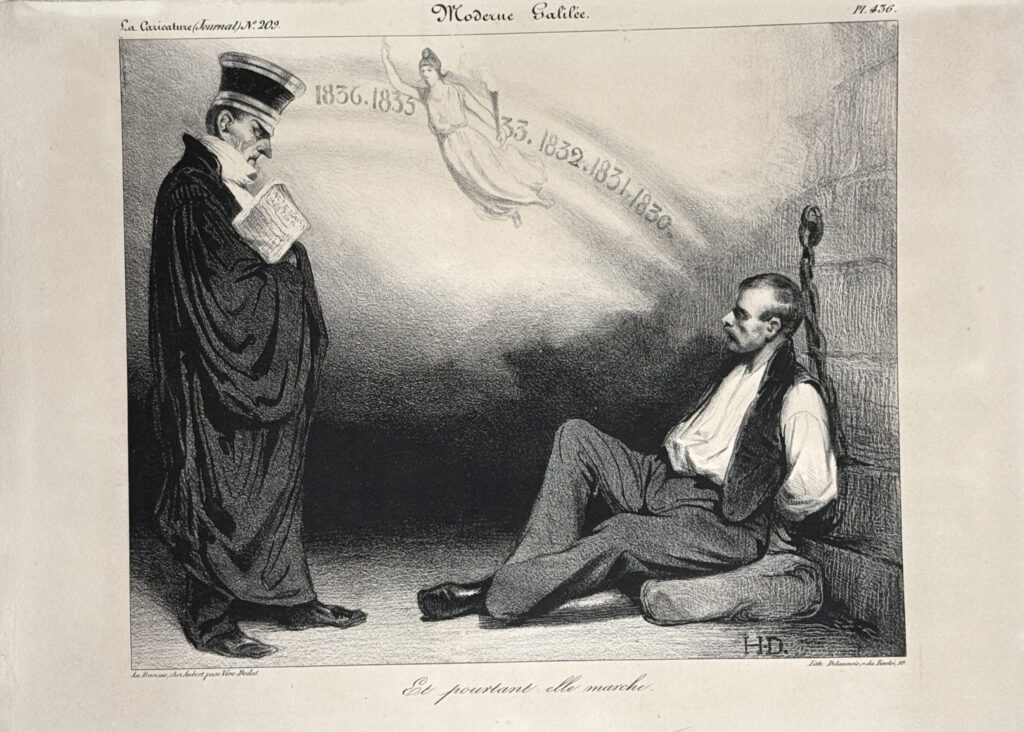
Reflecting an impressive professional image can require minimal resources. Examples might be as diverse as an attorney’s office having an original lithograph by Robert Rauschenberg in the waiting room or by contrast a late 19th century original lithograph of one of Daumier’s legal subjects. A small identifying label next to the work evokes the work’s significance, setting it apart from mere décor. The benefits of enriching an environment on a small scale is not different than for a large corporation.
Acquiring assets, depreciating their costs at the prospect of the art possibly gaining or retaining value can be an attractive side benefit. Choosing wisely can be done at virtually every price point, but that requires some guidance or at least some experience and thoughtful consideration. Donating or lending works to institutions offers a company a respected public image, institutional recognition and a benefit to its community.
While the Los Angeles area doesn’t boast the level of Wall Street and multinational collections mentioned above, there are numbers of formidable corporate, foundation and private collections that have had great benefit to the community, as well as to those individual entities. Museums are indebted to the largess of private collectors for their very existence. Consider the major museums bearing the names of the benefactors – J. Paul Getty, Armand Hammer, Norton Simon, Eli Broad. All began collecting art on a personal level and we are the beneficiaries of their generosity.
In terms of investing for a personal collection, that takes me to some thoughts for future articles. That’s in fact more complicated than a corporate or private business collection. It’s critical to recognize the changed landscape in a changing universe of institutions, a generational shift in collectors, the attrition of connoisseurship, the advancement of consumerism, the rise of the “mega gallery,” the loss of art journals and magazines, the web, branding, contemporary celebrity, etc. Pick a topic!
Loving art and living with objects that are meaningful really isn’t complicated. It’s enriching.
I’ll close with a short story of a young couple who visited my gallery with their baby in a stroller many years ago. They mentioned they had some funds and wanted to make an investment. I probably furrowed my brow hearing “investment,” so I asked if this was the investment for their child’s future education? They said, “no, we’re responsibly setting that aside.” I asked is this for your future in advanced age, to clothe feed or house you? “Of course not,” they scoffed and said, “no, that’s all addressed.” So I asked, “then what is this investment for?” “It’s for our future – our pleasure.” My response was to tell them that I can offer them immediate and continuing dividends, and they didn’t have to wait for the future if they consider works of quality and consequence, and with that criteria, acquire a work they love. I never saw them again, as I probably didn’t tell them what they wanted to hear. Be careful of those who do!
My most successful investment story goes back many decades, when a young song writer approached me with a desire to make an investment; a dispassionate financial transaction. I chose an exquisite Rembrandt etching. He was pleased enough. A couple years later, I approached him offering him a handsome gain — several times what he paid. His reply was, “Are you kidding? I’ll never sell that etching.”
That’s the best investment success I could ever hope for!
About the Author: Jack Rutberg began his career as a dealer of fine art in the early 1970s and established Jack Rutberg Fine Arts in 1979, one of Southern California’s longest established fine art galleries. Formerly located on La Brea Avenue in Los Angeles, the gallery moved to Pasadena in 2022, continuing to serve as a source for established and new collectors and museums internationally, offering a wide range of significant Historic, Modern, and Contemporary paintings, drawings, original prints, and sculpture by American, European, and Latin American artists.
He is a frequent speaker at symposiums and museums throughout the U.S., a commentator on television and radio, and has been profiled in local, national and international publications. His curatorial endeavors have been notable and include being curator for twelve years for the Galway International Arts Festival in Ireland.
Among numerous distinctions, Jack Rutberg was the recipient of the L.A. Artcore Annual “Award for Outstanding Contribution to the Arts,” and The Hollywood Arts Council “Charlie Award.” In 2023, UNESCO’s International Association of Art/USA awarded Jack Rutberg its first Lifetime Achievement Award.
Most recently, Jack Rutberg published a new book “A Hidden Story Revealed – Pasadena: L.A.’s Art Legacy,” critically cited as “a corrective…to the received history of postwar American art.”
DISCLAIMER: This column is provided for general informational and educational purposes only. It reflects the views and experience of the author and does not constitute legal, tax, accounting, investment, financial, medical, employment, human-resources, regulatory, compliance or other professional advice.
The information presented is general in nature and has not been prepared for, and does not take into account, the circumstances, objectives, needs or obligations of any particular individual or business. Nothing in this column should be relied upon as a substitute for advice from a qualified professional who has reviewed your specific circumstances.
Publication of this column does not create an attorney-client, accountant-client, financial adviser-client, consultant-client or other professional relationship between the reader and the author or any affiliated person or organization.
Laws, regulations, financial conditions, technologies and professional standards can change, and information that was accurate when published may later become outdated or inapplicable. Readers should independently verify information relevant to an important decision and consult appropriately qualified legal, tax, accounting, financial, investment, insurance, medical, employment, regulatory or other professional advisers before acting or refraining from acting on information contained in this column.
References to particular businesses, products, services, investments, strategies or practices are for informational purposes unless expressly identified otherwise and do not constitute an endorsement, recommendation or guarantee.
Images of works by Rauschenberg & Daumier inserted for clarity here do not appear in the original published article.