

Robert is Local News Pasadena’s Poet Laureate. He is a native of Pasadena and hikes regularly in the local foothills. His poetry has appeared in The New Delta Review, Upstairs at Duroc, The Denver Quarterly, ballast, and MyEatonCanyon.com, among other journals and venues. Robert is the author of The Canyon (Atmosphere, 2025). He is coauthor with Sandy Florian of Sophia Lethe Talks Doxodox Down (Atmosphere, 2021). He has kept the same haircut since 1983.
Running through December 24, the exhibit Jerome Witkin—Epic is now on view at Pasadena’s Jack Rutberg Fine Arts Gallery. Witkin has a strong following among artists, yet avowedly paints for a general audience.
A renowned figurative painter, Witkin was born in Brooklyn in 1939. With his drawings, Witkin demonstrated an aptitude for figurative art from childhood. He began taking art classes at age seven, and in 1954, he won first place in a drawing contest held by Seventeen magazine. The previous year, Witkin had begun to attend Manhattan’s High School of Music and Art.
He graduated from Manhattan’s Cooper Union School of Art in 1960. In 1961, at New York City’s Morris Gallery, Witkin had his first solo show.
As Sherry Chayat details in her monograph Life Lessons: The Art of Jerome Witkin (Second Edition, 2006), the young artist’s New York City milieu brought him into contact with a number of major painters.
Witkin met and became close to Ben Shahn (1898–1969), an artist prominent in the school of Social Realism. He became well acquainted with George Grosz (1893–1959), a Berlin-born painter who had fled Germany in 1933, just before the Nazis assumed power. Grosz’s satirical anti-Nazi artworks had led to death threats, and a collection of his political cartoons, The Face of the Ruling Class (1921), was among the books the Nazis burned.
Witkin also met Mark Rothko (1903–1970), a leading artist of the Abstract Expressionist school.
The Abstract Expressionists were ascendant in Witkin’s New York City art world, and the Social Realism that had flourished between the two world wars was in retreat, in part, Chayat notes, due to McCarthyism. The two schools of painting argued their cases via a series of manifestos.
Let’s consider one of these Barnett Newman’s 1948 article “The Sublime is Now,” published in The Tiger’s Eye, a short-lived but influential NYC-based arts magazine. You may have stood at the Grand Canyon’s rim and felt a transport of awe and wonder. That’s called the natural sublime. Newman’s concern is with the sublime in painting.
In his article, Newman (1905–1970) argues for abandoning the “props,” the traditional figurative “devices of Western European painting,” so as to discover sublime “exaltation” in the unimpeded expression of “absolute emotions” that abstraction allows. Such was Newman’s program for an abstract expressionism.
Newman pursued this program in his painting Vir Heroicus Sublimis (1950–1951). The Latin title translates as “Man, Heroic and Sublime.” The massive work (7′ 11 3/8″ x 17′ 9 1/4″) consists entirely of a red field marked by five narrow vertical strips of color (lighter red, white, black, lighter red again, and off white).
Newman’s painting has its sublimity, and, for example, Shahn’s Welders (1943) has its social realism.
But when does a painting become epic?
Here’s one answer: when an artist brings the sublime’s high, exalted pathos into depictions of day-to-day social reality. This would be a way to understand the word “epic” in the exhibit’s title: Jerome Witkin—Epic.
Artist Manuel Perea accompanied me to the exhibit. Perea is on intimate terms with painterly practice and has extensive knowledge of art history; I more fully realized this listening to Perea and Rutberg Gallery Associate Jonas Short expertly discuss the Witkin works on display.
These include drawings, portraits, small plein air works, and examples of the large canvases for which Witkin is most well-known and in which the epic quality most comes into play: narrative paintings that tell a story through composition, color, and imagery.
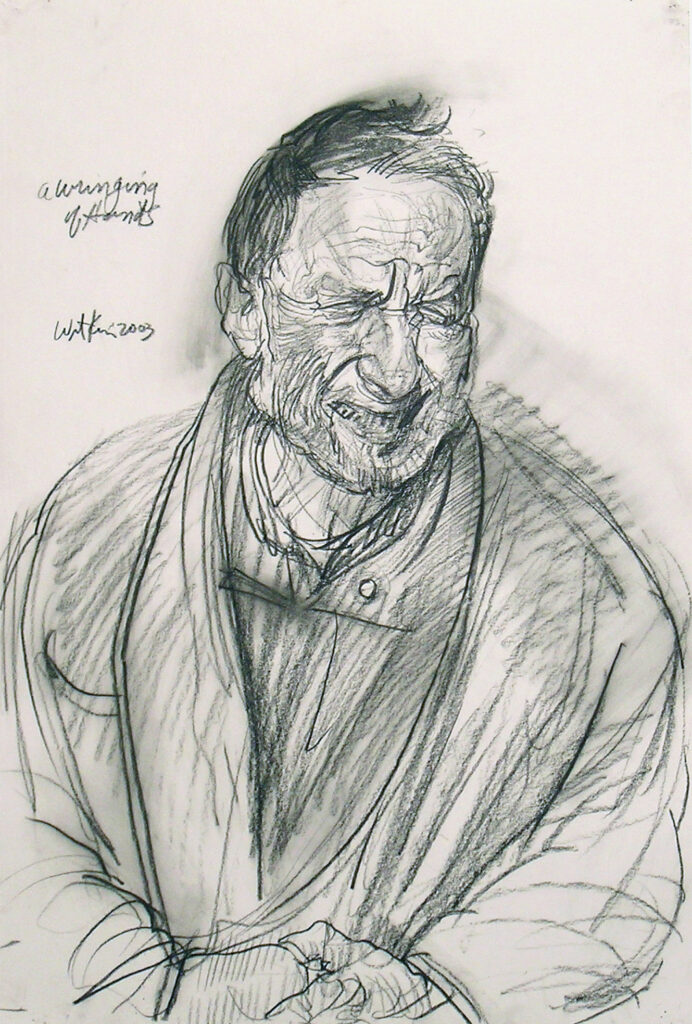
Perea was immediately impressed with Witkin’s drawings, specifically the self-portrait A Wringing of Hands (2003). Perea commented, “The line on the face is incredible.” I was able to appreciate how the drawing gives a vivid sense of Witkin’s face. As one of the experts in the room, Perea could appreciate the skill and technique by which Witkin deployed something two-dimensional, lines on paper, to achieve a vivid sense of something three dimensional, a face.
Across from A Wringing of Hands is another drawing, a nude titled Lauren McMahon Resting (1996). McMahon was Witkin’s model for the drawing, and Witkin wrote the title on the drawing itself adjacent his signature. As Short noted, another artist might have just signed and dated the drawing, but Witkin made sure to acknowledge his model by name as his collaborator.
Short agreed that for Witkin his models are active participants in his creative process. Witkin prefers to paint from life. That is, in his studio with his models Witkin often stages the scenes he wants to paint. For example, as Chayat relates, to paint a scene on a subway, Witkin had mocked up in his studio “a three-walled, life-sized subway car” into which his models could step.
These stagings can be quite meticulous, and Witkin brings complexity to their visual realization on canvas. For example, his painting Her Dream (1987) does “make the visible a little hard / To see,” to borrow lines from Wallace Stevens’s “The Creations of Sound,” a poem from Stevens’s 1947 collection Transports to Summer.
Stevens (1879–1955) is suggesting art avoid overtrodden paths to perception. Gazing at Her Dream, the visible becomes a little hard to see. With this painting, Short pointed out, the viewer looks into a mirror on a dresser. The mirror reflects a woman lying on a bed. The composition situates the viewer with her in the room, even on or standing near the bed, yet as a ghostly absence, given that the viewer nowhere appears in the mirror.
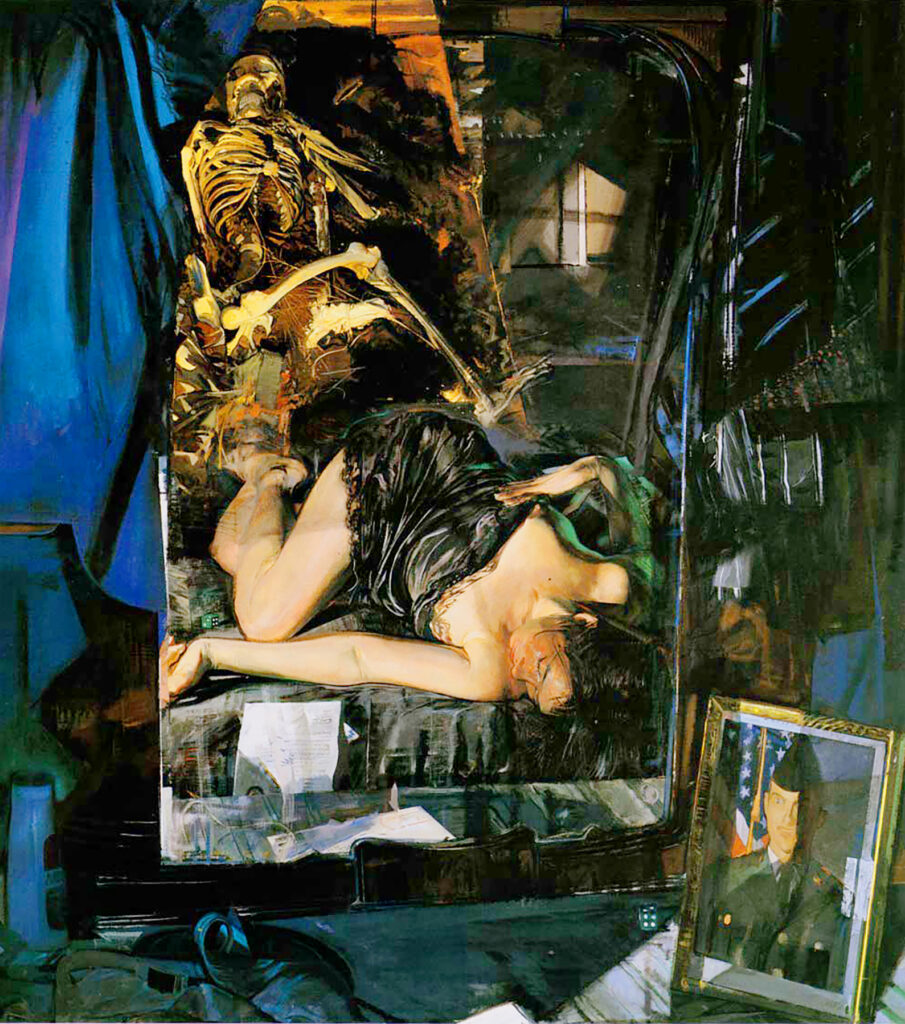
What about the skeleton? Perea suggested its juxtaposition with the woman invokes the Renaissance pictorial motif of death and the maiden. From exactly where comes the greenish light cast on the woman’s exposed breast?, Short wondered aloud. And remember: the painting’s title indicates we are looking into a dream. The scene’s confined space opens onto multiple vistas of story and meaning.
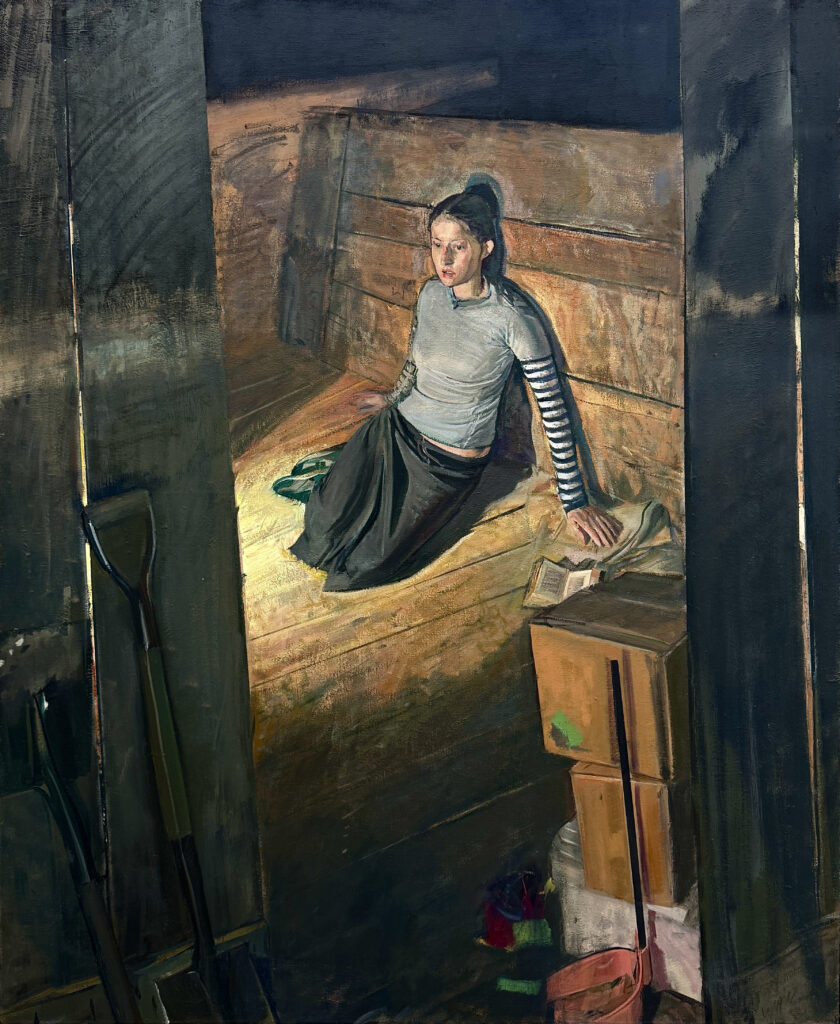
Her Dream is a complex composition. Though simpler, The Silence (2003–2004) has its own depths. Perea noted the importance of the hidden elements in the painting. At what or at whom is the young woman looking? We see her in a lit space, but we do not see the source of the light emanating from the hidden space towards which she looks. And there’s the detail that her nose is bloodied. What violence or violation might this imply?
Contemplating The Silence led me to ask about Witkin’s treatment of the human face as compared to that of another renowned figurative painter, the Irish-born Francis Bacon (1909–1992). Bacon’s paintings pursue an aesthetic of the grotesque, as in his Study for Three Heads (1962). Indulging a naïve polemic, I suggested that if Witkin is a figurative painter, Bacon is a disfigurative painter.
Perea set me straight by suggesting that Bacon’s grotesquerie is among Bacon’s strategies for making the visible a little hard to see. Also, Perea continued, there’s a parallel between Witkin and Bacon: Bacon engages horror, the twentieth century’s horrors, as does Witkin, especially in his works on the Nazi extermination camps, a study for one of which, Rebecca Stronger (1995), is included in the exhibit.
The conversation moved to the convergence of and irreducible distinction between the aesthetic and the ethical in painting. What are the stakes of making a little hard to see that from which we should never look away?
Here two biographical details Chayat mentions become relevant. In his Catholic-school youth, Witkin took to signing his works “FHGG”: “For the Honor and Glory of God.” Later on, over the doorway to his loft, Witkin inscribed “the Hebrew letters for Tikkun,” along with a translation: “to heal, repair, and transform the world.”
Biblical traditions and the tradition of the sublime are variously entangled, and in one way that presents an impasse to the epic sublime’s pursuit in painting.
On the one hand, Longinus’s first-century CE Greek treatise “On the Sublime,” to evoke sublimity, quotes Genesis 1.3: “Let there be light.” On the other hand, in his 1790 Critique of Judgement, the German philosopher Immanuel Kant (1724–1804), to evoke sublimity, quotes Exodus 20.4: “Thou shalt not make unto thee any graven image, or any likeness of any thing that is in heaven above, or that is in the earth beneath, or that is in the water under the earth.”
Is your painting a creation, or is your painting a likeness and so a graven image? Imagine an artist who attempts (A) to let light disclose creation shining forth but who refuses (B) to desecrate creation in a graven image. For a painting fully to do A without at all doing B would be a perhaps impossible standard.
To feel the necessity to struggle toward that standard, an artist need neither be Catholic, like Witkin’s mother, nor Jewish, like Witkin’s father. One need merely be an artist with the ambition to take on tradition, in both senses of “take on”: to embrace and to contest.
At the Witkin exhibit, this ambition and the sublime’s impasse are at work in Painter’s Crossing: To the Passions of Rembrandt (1976–1978). Imagine a contemporary painter taking on Rembrandt (1606–1669), widely considered to be among Western tradition’s greatest painters.
There are Rembrandt’s artistic passions, but Witkin’s title also refers to Rembrandt’s works on the Passion (Jesus’s final steps to and death on the cross), especially the paintings known as Rembrandt’s Passion Series (1633–1639).
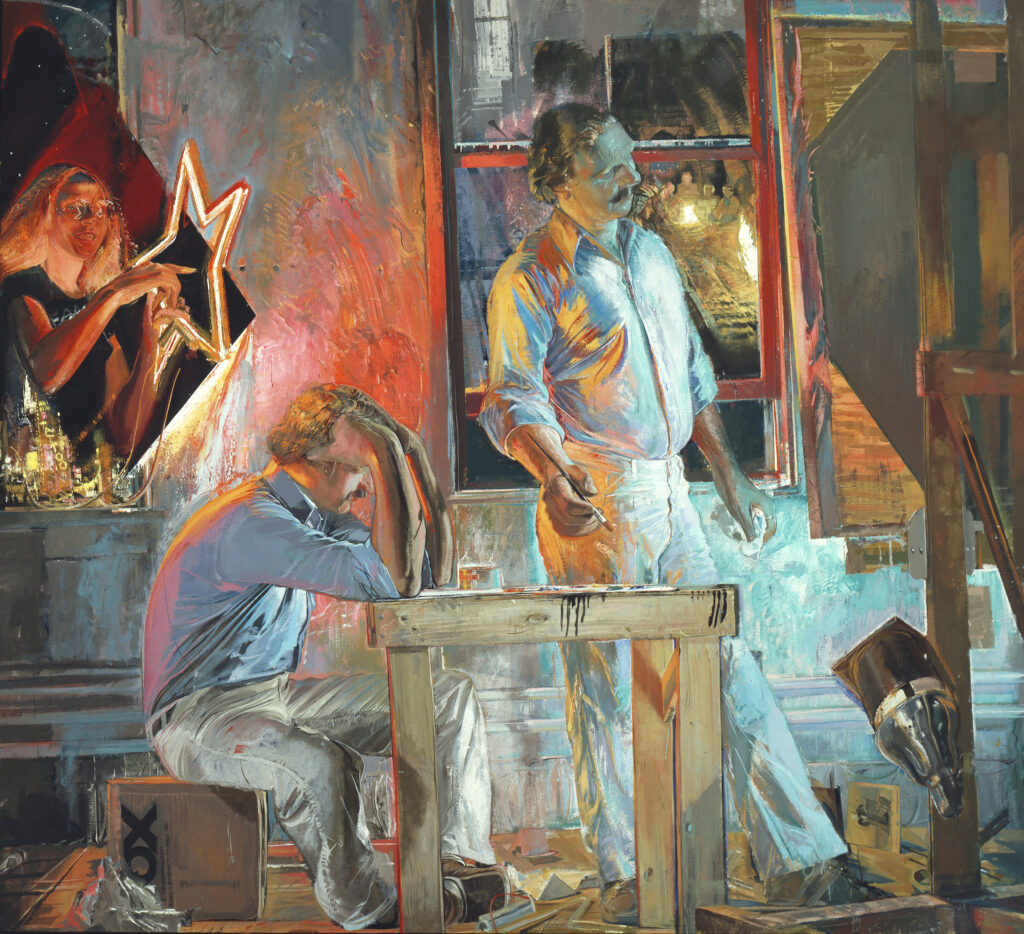
Painter’s Crossing shows the artist standing before a canvas. Behind him, a window reflects the scene he is painting. He may have Rembrandt’s Nativity painting Adoration of the Shepards (1646) in mind, though, distinct from the darkness enclosing the scene in that painting, his painting features a vista of night sky lit perhaps by stars. For a title of his painting, consider a phrase from Kant’s Critique of Practical Reason (1788): “The Starry Sky above Me, the Moral Law within Me.”
Yet we also see the painter seated at a utility table, before him on the table a can labeled “FAME” in red letters. Behind and above the seated artist, through a window, comes a muse figure wearing a t-shirt bearing the letters “FAME” in white. She holds a neon star, and behind her is a starry night. As if directing his work, she points toward the standing painter, the reddish pink glow from her neon star falling on his back, as the window reflection shows.
Does Painter’s Crossing depict one moment or two? Is the creatively blocked seated painter daydreaming of being the standing painter confidently at work (one moment), or has the standing painter at work arisen from his seated reverie to take up his brush (two moments)?
How are we to read the painter’s muse? She associates with a garish downtown city scene, with one building sporting a sign spelling out in yellow light the word “TATTOO.” Are not tattoos graven images? Is she beguiling the painter to coin a derivative likeness of a Rembrandt?
Or does she inspire him to find his own light of creation? Notice how the rectangle of yellow light in the lower left portion of the city scene echoes in the rectangle of light the biblical-style figures gather around in the painting within the painting.
Luckily, in the Rutberg Gallery, there is a bench in front of Painter’s Crossing, allowing visitors to sit and take the time needed to appreciate the painting and ponder the questions it provokes.