

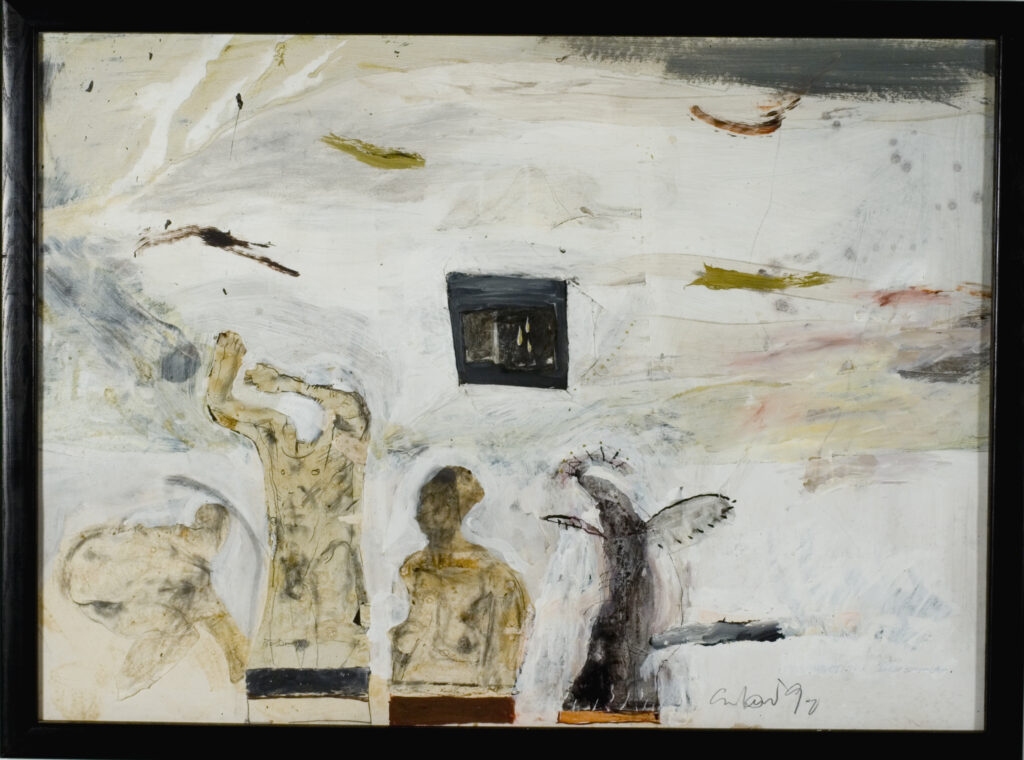
Although Ireland has produced some of the world’s best late-19th and 20th century writers and poets, its roster of well-known visual artists during this same period is sparse in comparison. Both the father and the brother of William Butler Yeats, the country’s best-known poet, were successful professional painters, but remain obscure next to their famed family member. Many art historians, looking beyond the isolated example of Francis Bacon, concur that 82-year-old Patrick Graham deserves much credit for opening Irish visual arts to the world.
Like Bacon, Graham is recognized for his role in moving Irish painting out of a stale, academic Anglo-centric style. Both their bodies of work took on the raw idiom of German Expressionism and (in hindsight) the Neo Expressionist movement in America and Europe during the late 1970’s and 1980’s. This partially explains why Graham attracted and continues to enjoy a strong international profile.
The symbiosis between poetry and painting in Graham’s work is immediately evident in a small piece titled Deposition #6. All of the artist’s output presents haunting explorations of his psyche and soul. This little gem does so with a masterful blend of drawing and painting media. Graham’s Deposition series plays a game of hide and seek with the artist’s own visage and identity, much as John Ashbery’s iconic poem, “Self Portrait in a Convex Mirror” references the Italian Mannerist Parmigianino’s rendering of a distorted reflection of himself. Yet, as in this line from Ashbery’s poem, Graham’s drawing also “has shut itself out/and in doing so shut us accidentally in …”
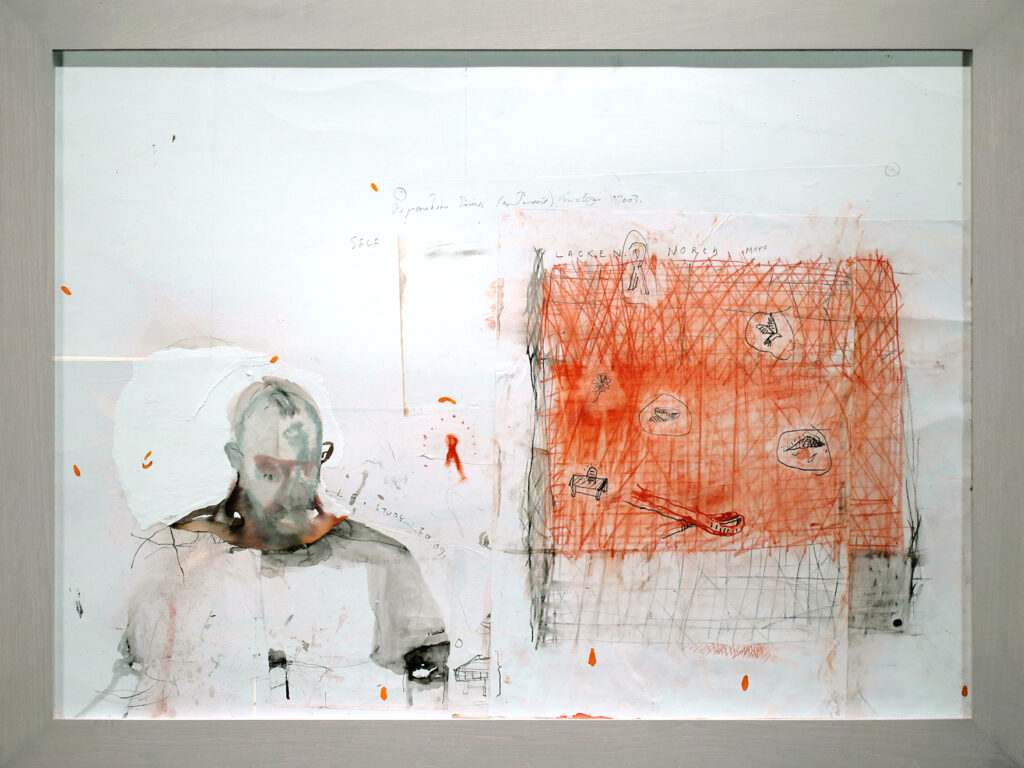
Deposition in Christian terminology refers to Christ’s descent from the cross, and has long stood as a symbol of suffering and rebirth. Each work in the Deposition series presents a faint, smudged, primitively rendered image of the artists face and body. Bruised and fragmented, they simultaneously step forward and recede as if to hide from both his self-analytical gaze and the probing eyes of the viewer. The ink and paint of each drawing float over pieces of milky-white paper that forma subconscious sea. Handwritten words and
notes surface and surround many of the fragmentary portraits. At times resembling a Rorschach ink blot test, these pieces represent a psychoanalytic self-accounting (that is, a deposition), each work functioning as both an inventory and a manifest.
While these fragile palimpsests pack disproportionate power into small spaces, Graham’s larger works free the artist’s expressionistic impulse into lyrical flights, especially as they are structural experiments enlivened by Irish mythologies and narratives. The sensual yet ethereal A Lark in Morning is industrial-looking to the eye yet painterly at its core. It shows Graham literally turning his back on aesthetic conventions, as he has executed the work on the reverse sides of two stretched canvases. The paint-splashed stretcher bars become frames that function metaphorically
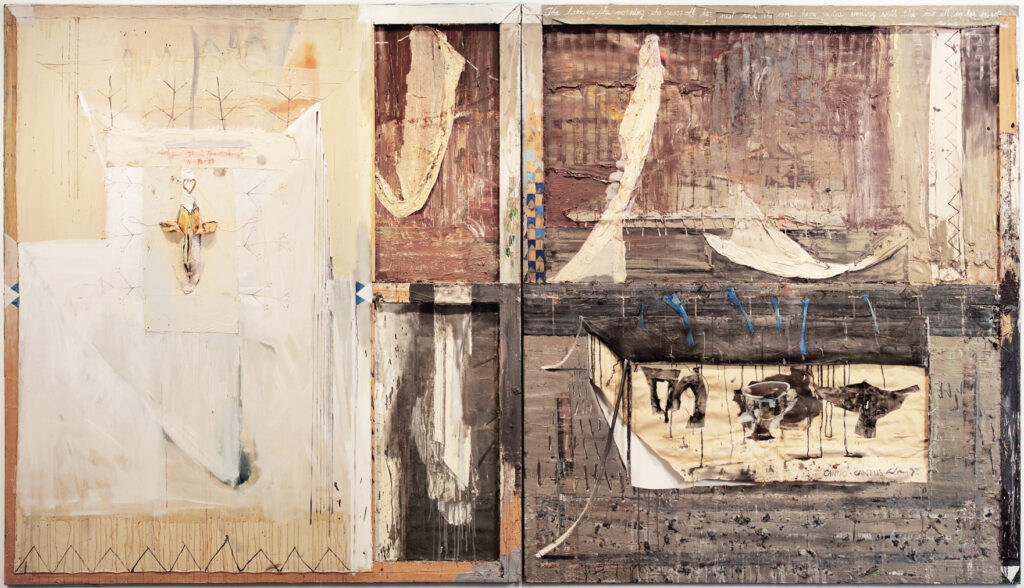
as doors through which the painting seems to enter and exit. In Irish folklore the lark symbolizes the joy, hope and optimism of the break of day, yet this piece challenges us with far more than melodic birdsong. On the left panel is built up a molded mass of crumbling cloth and paint into a visual blend of a vagina and a crucifix. Wax-coated strips of Plexiglas flap like disembodied wings across both panels, infusing the work with an evocation of fecundity at once sacred and earthy.
Another large oil and mixed-media diptych, Dead Swan/Captain’s Hill, forges an apocalyptic image that may haunt viewers after they have left the show. At first glance the diptych suggests medical x-rays or a computer data print-out. Looking more carefully across a scratched and streaked field of flat black paint one perceives a forest of small blue gravestone crosses dotting the entire picture plane. Under a sickly pewter-colored night sky the artist places child-like drawings of airplanes dropping bombs on the landscape below.
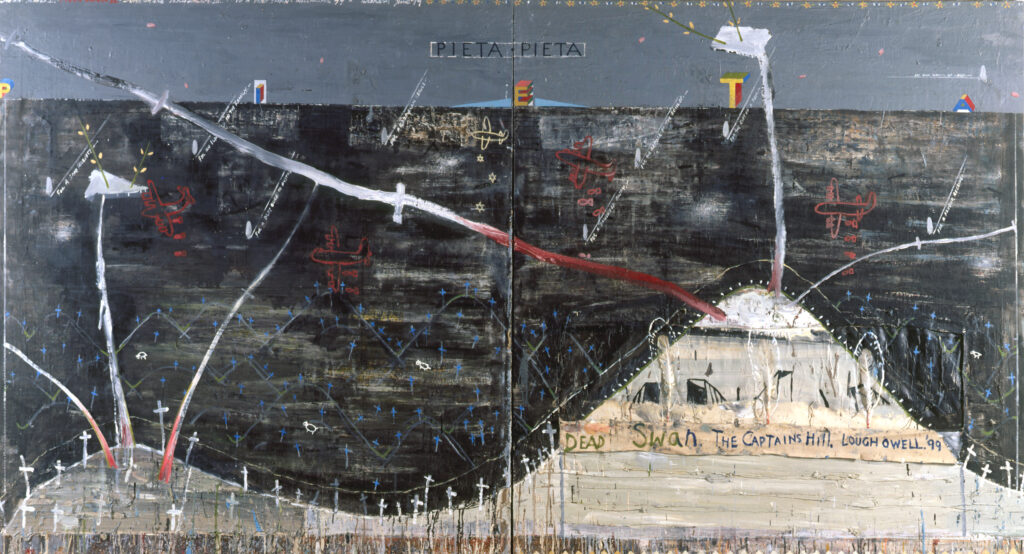
Signs label places of importance in Graham’s life. Other lines of text reveal plaintive messages directed to God, akin to those left in Catholic churches and shrines around the world. It is a strange cathexis of disparate geographical locations and innocently rendered scenes of violence. The totality of Patrick Graham: Notes from Ireland raises and then responds to the often-posed question whether one of the lifelines left to humanity is art.
~ Andy Brumer is a poet, book reviewer and art writer, whose work has appeared in The New York Times BookReview, The Los Angeles Times, The San Francisco Chronicle/Examiner, Artweek, Artscene, Visual Art Source, and many other publications. His most recent book of poetry, with drawings by Joseph Slusky, is Below Understanding. He also writes about golf.